
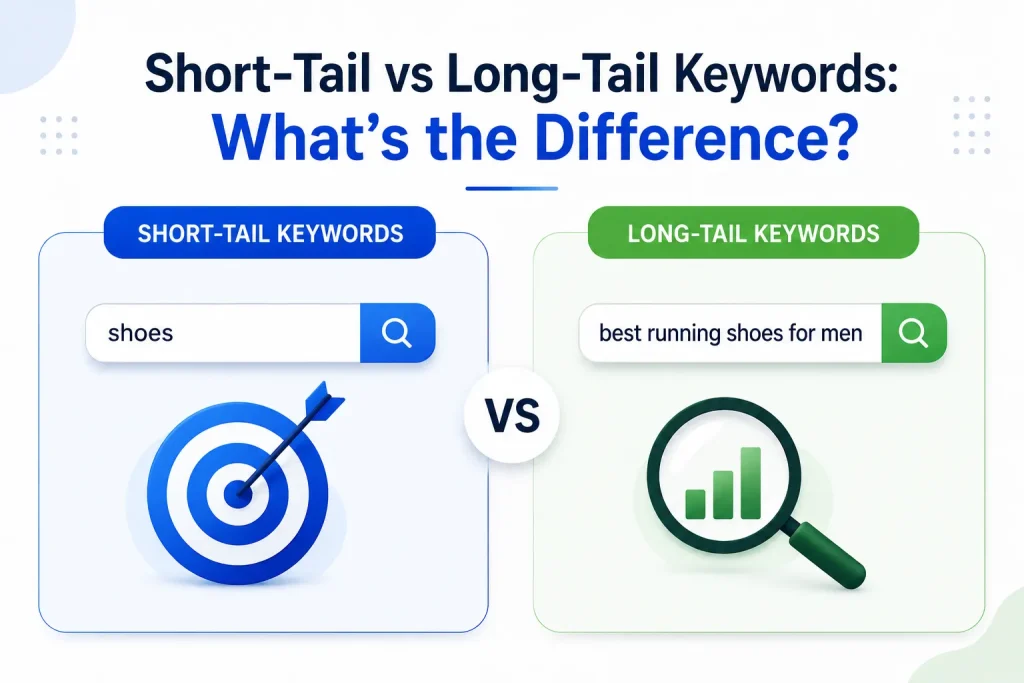
Choosing the right keywords is an important part of an effective SEO strategy. Understanding Short-Tail vs Long-Tail Keywords helps businesses create content that matches what people are actually searching for. While some keywords are broad and highly competitive, others are more specific and closely connected to user intent.
This article explains the difference between short-tail and long-tail keywords, provides practical examples, and helps you understand when each keyword type can be useful.
In This Article
- What short-tail keywords are
- What long-tail keywords are
- Short-tail vs long-tail keyword differences
- Examples of both keyword types
- How businesses can choose the right keywords
What Are Short-Tail Keywords?
Short-tail keywords are broad search terms that usually contain one to three words. They describe general topics and can attract a wide range of searches.
For example:
- SEO
- Digital marketing
- Running shoes
- Website design
These short-tail keyword examples have a broad meaning. Someone searching for SEO, for instance, could be looking for a definition, services, tools, courses, or general information.
Because the search intent can vary significantly, short-tail keywords may be more competitive and require strong topical relevance to target effectively.
What Are Long-Tail Keywords?
Long-tail keywords are more specific search phrases, usually containing several words. They often provide clearer information about what the user wants.
Some long-tail keyword examples include:
- SEO services
- best digital marketing agency for startups
- how to improve website search visibility
- affordable website design services in Mumbai
These keywords are more detailed and can help businesses create content for a specific audience or requirement. A longer search phrase often provides stronger clues about the user’s search intent.
Short-Tail vs Long-Tail Keywords: The Key Differences
The main difference between short-tail keywords vs long-tail keywords is their level of specificity.
Short-tail keywords are broad and can reach a larger audience. However, the audience may have different intentions behind the same search term.
Long-tail keywords are more detailed and usually focus on a particular need, question, product, or service.
For example:
- Short-tail keyword: SEO
- Long-tail keyword: SEO strategy for small businesses
The second phrase clearly provides more context. This makes long-tail terms useful for creating focused, relevant content that answers specific user requirements.
Neither keyword type is automatically better. The right choice depends on your business goals, audience, content topic, and search intent.
When Should You Use Short-Tail Keywords?
Short-tail keywords can be useful when building content around broad topics and important SEO keyword categories.
They may work well for:
- Main service pages
- Broad educational topics
- Category pages
- Top-level website content
For example, a comprehensive page about Search Engine Optimization (SEO) may naturally target broader keyword themes while covering related concepts in detail.
The goal should not be to use broad keywords repeatedly. Instead, create useful content that establishes clear topical relevance.
When Should You Use Long-Tail Keywords?
Long-tail keywords are useful when your content answers a specific question or addresses a particular requirement.
They can be effective for:
- Blog articles
- FAQs
- Service-specific pages
- Problem-solving content
- Niche audience searches
For example, instead of creating generic content about digital marketing, a business could address a specific topic such as digital marketing strategies for local businesses.
Using different types of SEO keywords strategically can help businesses build a more complete content structure around both broad topics and specific search queries.
How to Choose Between Short-Tail and Long-Tail Keywords
A strong keyword strategy usually considers both types of search terms. Start by understanding what your audience wants and the purpose of each page.
Use short-tail keywords for broader topics where comprehensive coverage is required. Use long-tail keywords when addressing specific questions, services, or user needs.
The most important factor is relevance. Your keywords should match the page content and provide useful information to the intended audience rather than being added simply for search visibility.
Frequently Asked Questions
Q1. What is the main difference between short-tail and long-tail keywords?
Ans: The difference between short-tail and long-tail keywords is mainly specificity. Short-tail keywords are broad, while long-tail keywords are more detailed and targeted.
Q2. Are long-tail keywords better for SEO?
Ans: Long-tail keywords are not automatically better, but they can be useful for targeting specific user needs and creating focused content.
Q3. How many words are in a short-tail keyword?
Ans: A short-tail keyword usually contains one to three words, although keyword classification should focus more on specificity than an exact word count.
Q4. Can a website use both short-tail and long-tail keywords?
Ans: Yes. A well-planned SEO strategy can use both SEO keyword categories to cover broad topics and specific search queries across different pages.
Conclusion
Understanding Short-Tail vs Long-Tail Keywords helps businesses make better content and keyword decisions. Broad keywords can support major topics, while specific phrases can address clearer user requirements.
The best approach is to focus on search intent, relevance, and useful content rather than choosing keywords based only on their length.
Build a More Focused Keyword Strategy for Your Business
Choosing the right keywords requires more than selecting popular search terms. A professional SEO strategy should consider your audience, business goals, search intent, and the topics your website needs to cover.
TVM Info Solutions provides professional digital marketing and SEO support to help businesses build relevant strategies for stronger online visibility and sustainable digital growth.
📞 Call Us: +919004590039
📧 Email: contact@tvminfo.com
Our Business Automation Solutions:
💬 ChatKar – Turn WhatsApp chats into sales: https://chatkar.com/
🌟 StarCreator – Build AI automations: https://starcreator.co/
📧 AutoMailSend – Own your email marketing: https://automailsend.com/
🎯 AttractLead – Capture & convert leads automatically: https://attractlead.in/