
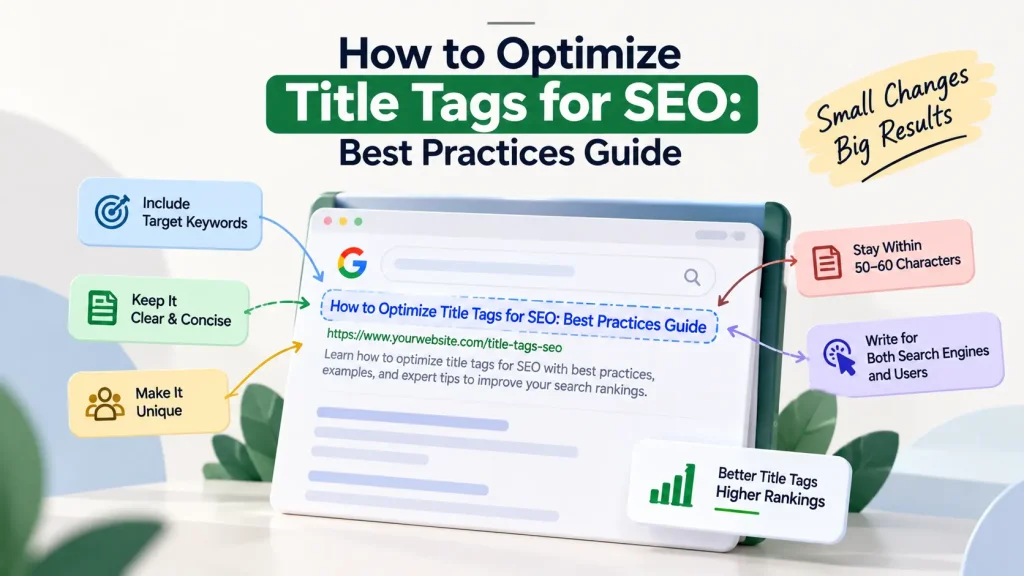
Title tags are one of the most important on-page elements for helping search engines and users understand a webpage. When you optimize title tags for SEO, you can create clearer page descriptions, improve relevance for target searches, and encourage more users to click your result.
This guide explains what is a title tag, how to create effective titles, and the most important title tag SEO best practices for business websites.
In This Article
- What a title tag is and why it matters
- How to optimize title tags for SEO
- Important title tag SEO best practices
- Common title tag mistakes to avoid
- Why title tag optimization matters for businesses
What Is a Title Tag and Why Does It Matter?
A title tag is an HTML element that helps describe the main topic of a webpage. It commonly appears in search engine results and browser tabs.
A well-written title helps users quickly understand whether a page matches their search. For search engines, it provides an important signal about the page’s subject and relevance.
For example, instead of using a vague title like “Services”, a business could use a more descriptive title such as “Digital Marketing Services for Business Growth”.
The goal is to make the title clear, relevant, accurate, and useful.
How to Optimize Title Tags for SEO
When learning how to optimize title tags, start by identifying the primary topic and search intent of the page.
Place your main keyword naturally where it makes sense, preferably without making the title sound repetitive or forced. The title should clearly describe what visitors will find after clicking.
Keep every page title unique. Different pages targeting different topics should not use identical or nearly identical title tags.
A good title should balance three elements:
- Keyword relevance
- Clear page description
- User appeal
Avoid writing titles only for search engines. If the wording sounds unnatural to a real person, revise it.
Title Tag SEO Best Practices to Follow
Effective title tags for SEO should accurately represent the page content. A misleading title may attract clicks initially but can create a poor user experience when visitors do not find what they expected.
Use these important practices:
- Write a unique title for every important page
- Include the primary topic naturally
- Keep the wording clear and easy to understand
- Match the title with the page content
- Avoid excessive keyword repetition
- Consider adding your brand name when appropriate
It is also useful to place the most important information early in the title, especially when the title contains multiple elements.
Common Title Tag Optimization Mistakes
One common mistake is keyword stuffing, such as repeating the same keyword several times in one title. This can make the title difficult to read and less useful for users.
Another mistake is creating titles that are too generic. A title should communicate the specific purpose of the page rather than simply naming a broad category.
Businesses should also avoid using the same title across multiple important pages. Title tag optimization works best when each title accurately reflects the individual page and its search intent.
Why Title Tags Matter for Business Websites
Title tags are a small but important part of a broader Search Engine Optimization (SEO) strategy. They work alongside relevant content, headings, website structure, and other on-page SEO factors to improve how clearly a webpage communicates its topic.
For businesses managing multiple website pages, reviewing title tags regularly can help maintain consistency and relevance. Professional SEO services can also be useful when businesses need a structured approach to on-page optimization, keyword targeting, and website content.
Frequently Asked Questions
Q1. What is a title tag in SEO?
Ans: A title tag is an HTML element that describes the main topic of a webpage and commonly appears in browser tabs and search engine results.
Q2. How do you optimize title tags for SEO?
Ans: To optimize title tags for SEO, use a clear description of the page, include the main topic naturally, match search intent, and avoid unnecessary keyword repetition.
Q3. Should every webpage have a unique title tag?
Ans: Yes. Important webpages should have unique title tags that accurately describe their specific content and purpose.
Q4. Can title tags improve search rankings?
Ans: Title tags are one of several on-page SEO factors that help search engines understand page topics. They should be optimized as part of a broader SEO strategy rather than treated as a guaranteed ranking solution.
Conclusion
Effective title tag optimization is about making every webpage easier to understand for both users and search engines. Focus on clarity, relevance, uniqueness, and search intent instead of simply adding keywords.
A well-planned title tag can strengthen your overall on-page optimization and create a better experience for users searching for your products, services, or information.
Improve Your Website With Professional SEO Services
If your business needs help reviewing and improving important on-page SEO factors, TVM Info Solutions provides professional SEO services designed to support stronger search visibility and a more structured website optimization strategy.
Discuss your website requirements with our team to identify the right approach for your business.
📞 Call Us: +919004590039
📧 Email: contact@tvminfo.com
Our Business Automation Solutions:
💬 ChatKar – Turn WhatsApp chats into sales
🌟 StarCreator – Build AI automations
📧 AutoMailSend – Own your email marketing
🎯 AttractLead – Capture & convert leads automatically