
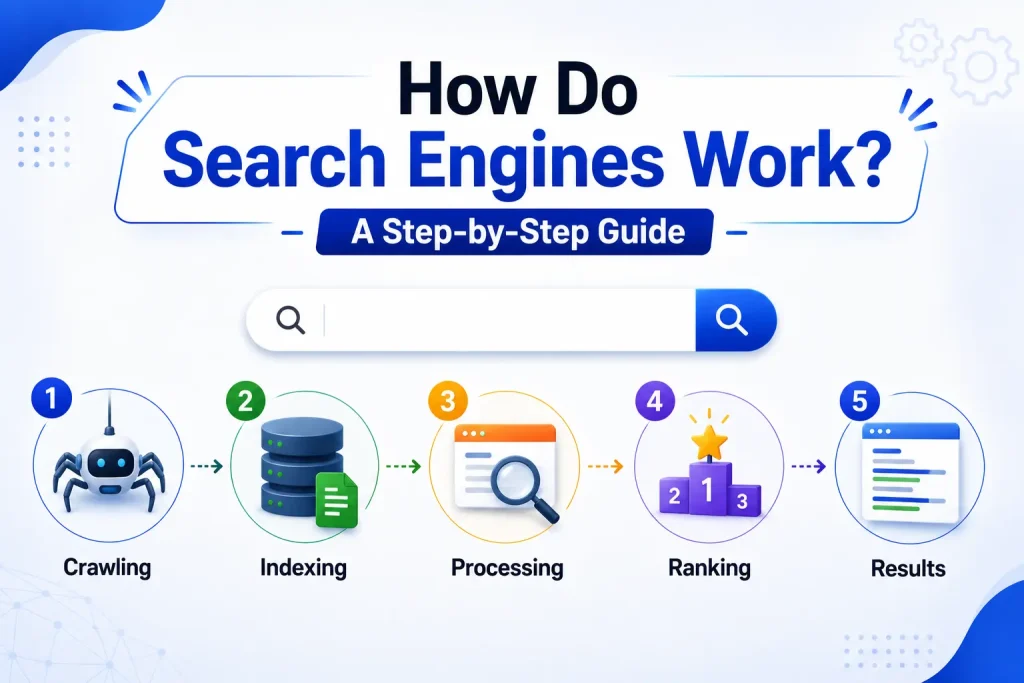
When people search for information online, search engines help them discover the most relevant pages from billions of websites. Understanding how search engines work is useful for business owners, marketers, and website managers because it explains why website structure, content, and optimization matter.
The basic search engine process involves discovering websites, understanding their content, storing information, and selecting relevant results for user searches. This guide explains how search engines work step by step and what businesses should know about improving their website’s search visibility.
In This Article
- How search engines discover websites
- How search engine crawling works
- How search engines index websites
- How search engines rank search results
- Why the search engine process matters for businesses
1. How Do Search Engines Find Websites?
Search engines discover pages through automated programs commonly called crawlers or bots. These programs move across the web by following links between pages and identifying new or updated content.
Understanding how search engines find websites helps businesses recognize the importance of a clear website structure. Internal links can help search engines discover important pages, while properly organized navigation makes website content easier to understand.
Website owners can also provide information about their pages through tools such as XML sitemaps, which can support the discovery process.
2. How Search Engines Crawl Websites
Search engine crawling is the process through which automated bots visit web pages and examine their content. Crawlers may analyze elements such as page content, links, images, and technical information.
However, not every page is necessarily crawled immediately. Factors such as website accessibility, technical errors, internal linking, and crawl instructions can affect how efficiently search engines access a website.
A technically well-structured website makes it easier for search engines to understand which pages are available and important.
3. How Search Engines Index Websites
After crawling a page, a search engine may process and store information about that page in its index. Search engine indexing allows the search engine to retrieve potentially relevant pages when users perform searches.
When considering how search engines index websites, content quality and clarity matter. Search engines need to understand what a page is about and how it relates to a user’s search query.
Clear headings, relevant content, descriptive page information, and logical website organization can help communicate the purpose of a page more effectively.
4. How Search Engines Rank Results
When someone enters a search query, the search engine evaluates potentially relevant indexed pages and determines which results may best answer that query.
Ranking can involve many signals and systems. Relevance, content quality, website usability, page experience, and the overall usefulness of information can all play a role.
This is why effective SEO is not simply about adding keywords to a page. A strong SEO approach focuses on helping search engines understand content while also creating a useful experience for real users.
5. Why the Search Engine Process Matters for Businesses
Understanding how search engines work helps businesses make better decisions about their websites and digital content. If important pages cannot be discovered, crawled, or properly understood, their visibility in search results may be limited.
Businesses should focus on creating useful content, maintaining a technically accessible website, organizing pages logically, and developing a clear SEO strategy based on their audience and business goals.
For companies that need professional support, TVM Info Solutions provides Search Engine Optimization (SEO) services to help businesses improve their website visibility through relevant optimization strategies.
Frequently Asked Questions
1. How do search engines work step by step?
Search engines generally discover websites, crawl their pages, process and index information, and then evaluate relevant pages when users perform a search.
2. What is search engine crawling?
Search engine crawling is the process where automated bots visit web pages to discover and examine website content and links.
3. What is search engine indexing?
Search engine indexing is the process of processing and storing information about eligible web pages so they can potentially appear for relevant search queries.
4. Can SEO help search engines understand a website?
Yes. Proper SEO techniques can improve website structure, content clarity, internal linking, and technical accessibility, helping search engines better understand important pages.
Conclusion
Understanding how search engines work provides a strong foundation for building an effective online presence. From crawling and indexing to evaluating relevant search results, every stage of the process highlights the importance of useful content and a well-structured website.
Businesses that understand these fundamentals can make more informed decisions about their SEO strategy and long-term search visibility.
Build a Stronger Foundation for Search Visibility
A successful website needs more than good-looking pages. Businesses must consider how search engines discover, understand, and evaluate their content. TVM Info Solutions provides professional SEO support for businesses looking to strengthen their search presence with a structured and relevant strategy.
📞 Call Us: +919004590039
📧 Email: contact@tvminfo.com
Our Business Automation Solutions:
💬 ChatKar – Turn WhatsApp chats into sales: https://chatkar.com/
🌟 StarCreator – Build AI automations: https://starcreator.co/
📧 AutoMailSend – Own your email marketing: https://automailsend.com/
🎯 AttractLead – Capture & convert leads automatically: https://attractlead.in/
Pingback: How Long Does SEO Take to Show Results? | SEO Timeline
Pingback: Why Keyword Research Is Important for SEO Success
Pingback: What Are LSI Keywords? The Secret to Better SEO Rankings
Pingback: What Is On-Page SEO? Meaning, Techniques and Key Factors
Pingback: Complete On-Page SEO Checklist for Website Optimization
Pingback: How to Optimize Title Tags for SEO: Best Practices Guide
Pingback: Write SEO-Friendly Meta Descriptions: Best Practices Guide
Pingback: Keyword Placement in SEO Content: Best Practices Guide
Pingback: How to Optimize Images for SEO
Pingback: Image Alt Text: SEO Guide for Better Image Optimization
Pingback: On-Page SEO Mistakes: Common Mistakes to Avoid
Pingback: Internal Linking Strategy: Build Better Website Connections
Pingback: Technical SEO: Understanding How It Works