
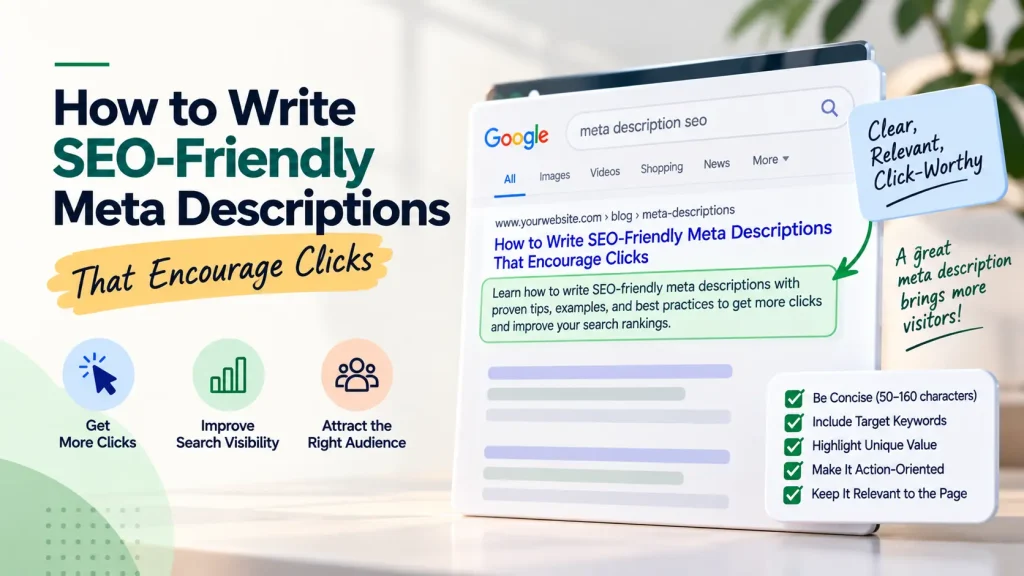
A well-written meta description can help users understand what a webpage offers before they visit it. While it is not a direct ranking factor, a relevant and compelling description can improve how your page appears in search results and encourage qualified users to click.
To Write SEO-Friendly Meta Descriptions, focus on accurately summarizing the page, matching search intent, and giving users a clear reason to visit. This article explains how to write meta descriptions, the ideal approach to length, and important meta descriptions for SEO best practices.
In This Article
- What is a meta description and why it matters
- How to write a clear and relevant meta description
- How to use keywords naturally
- Understanding meta description length
- Common mistakes to avoid
What Is a Meta Description?
If you are asking what is a meta description, it is a short HTML summary that describes the content of a webpage. Search engines may use it as the snippet displayed below the page title in search results.
A good description should quickly answer an important question: What will the user find on this page?
For example, instead of writing a vague description such as “Learn more about our services,” a specific description explains the actual value of the page.
Clear, relevant, and user-focused descriptions can make search listings easier to understand.
How to Write Meta Descriptions That Match Search Intent
The best approach to how to write meta descriptions is to begin with the page’s purpose and the user’s likely search intent.
A strong meta description should:
- Accurately summarize the page
- Explain the main benefit or information available
- Use clear and natural language
- Match the topic and page content
- Encourage relevant users to click
For example, if a page explains SEO services, the description should clearly mention the type of SEO support offered rather than making broad or unrelated claims.
The goal is not simply to attract clicks. The description should set the right expectation so visitors find content relevant to their search.
Use Keywords Naturally in Meta Descriptions for SEO
Keywords can help reinforce the relevance of a page, but they should never make the description sound repetitive or unnatural.
When creating meta descriptions for SEO, include the primary topic when it genuinely fits the sentence. You can also use related terms that help explain the page more clearly.
Avoid repeating the same keyword multiple times. Instead, write for the reader first.
A natural description is usually more useful than one overloaded with search terms. Relevance, clarity, and accuracy should guide your writing.
Understanding the Meta Description Character Limit
There is no single guaranteed meta description character limit because search engines can display different amounts of text depending on the device, query, and available space.
Instead of writing to an exact character count, focus on creating a concise and meaningful summary. Keep the most important information near the beginning and avoid unnecessary words.
It is also important to remember that search engines may sometimes generate a different snippet from the page content when they consider it more relevant to a user’s query.
Title and Meta Description SEO Best Practices
Effective title tag optimization and meta description writing work together to create a clear search result listing.
Follow these practical best practices:
- Write a unique description for important pages
- Keep the content specific to the page
- Avoid duplicate descriptions
- Use a clear benefit or value proposition
- Do not make misleading promises
- Review descriptions when page content changes
For businesses managing many webpages, maintaining consistent on-page optimization can become challenging. A structured Search Engine Optimization (SEO) strategy helps ensure important page elements support both search visibility and user experience.
Frequently Asked Questions
Q1. How do I write an SEO-friendly meta description?
Ans: Write a concise summary that accurately explains the page, matches user intent, and naturally includes the main topic or relevant keyword.
Q2. What is the ideal meta description length?
Ans: There is no fixed length that guarantees full display. Focus on writing a concise, useful description with the most important information placed early.
Q3. Should every page have a unique meta description?
Ans: Important pages should have unique descriptions whenever possible. This helps users and search engines better understand the specific purpose of each page.
Q4. Do meta descriptions directly improve rankings?
Ans: Meta descriptions are not generally considered a direct ranking factor. However, relevant descriptions can improve how users understand your search result and may encourage qualified clicks.
Conclusion
To Write SEO-Friendly Meta Descriptions effectively, focus on clarity, relevance, search intent, and accurate page summaries. A strong description should help users understand what they can expect before clicking.
When combined with quality content and effective on-page SEO, well-written meta descriptions can contribute to a clearer and more useful search experience.
Improve Your Website’s Search Listings With Professional SEO Support
Writing effective titles and meta descriptions is an important part of maintaining a well-optimized website. TVM Info Solutions provides professional SEO support to help businesses improve important on-page elements and strengthen their overall search strategy.