Anchor text is the visible, clickable text within a hyperlink. It helps users understand where a link will take them and gives search engines additional context about the linked page. Understanding anchor text in SEO is therefore important when building internal links, creating useful content, and developing a clear website structure.
The right anchor text should be descriptive, natural, and relevant to both the linking page and the destination. This guide explains what is anchor text, the main types, how it supports SEO, and practical ways to use it effectively.
In This Article
- What anchor text means in SEO
- How anchor text works
- Types of anchor text
- Best practices for using anchor text
- Common anchor text mistakes
What Is Anchor Text in SEO?
Anchor text is the clickable wording used in a hyperlink. For example, in the sentence “Explore our SEO services,” the words “SEO services” are the anchor text.
The anchor text meaning goes beyond simply making a link clickable. It provides context about the page being linked to. Descriptive wording can help users understand what they can expect after clicking and can also help search engines interpret relationships between pages.
For example, “website development services” provides more useful context than a generic phrase such as “click here.”
How Does Anchor Text Work?
When a page links to another relevant page, the anchor text acts as a small contextual signal. It connects the wording surrounding the link with the destination page.
For example:
Good: Learn more about website development services.
Less useful: Click here to learn more.
The first example clearly communicates what the linked page is about. This improves navigation and creates a more understandable website experience.
For internal links, descriptive anchor text can also help visitors discover related content and important service pages without interrupting the natural flow of the article.
Types of Anchor Text
There are several common types of anchor text used in SEO:
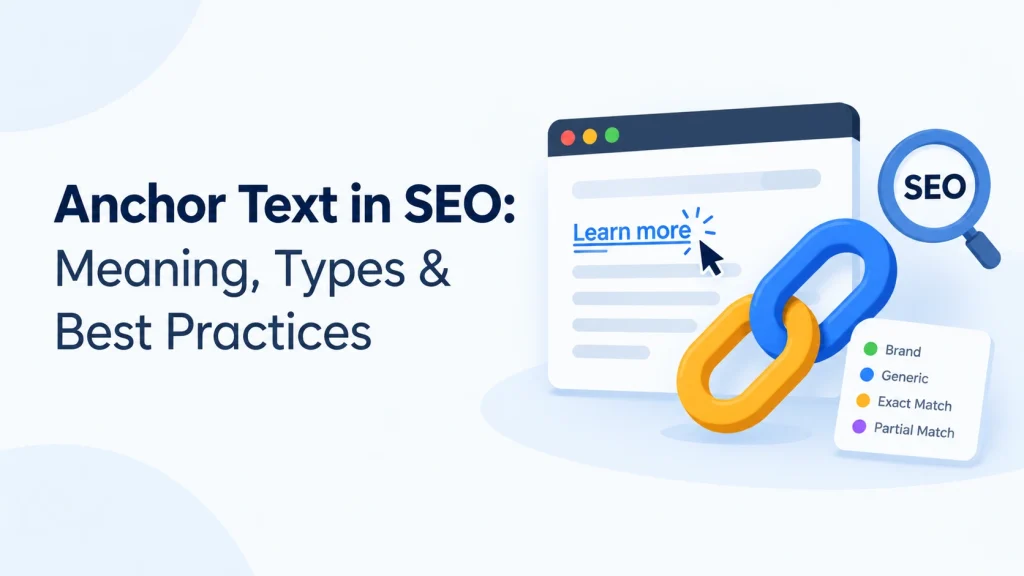
- Exact-match: Uses the target keyword exactly, such as “anchor text in SEO.”
- Partial-match: Includes the keyword with additional wording, such as “best practices for anchor text.”
- Branded: Uses a company or brand name as the link text.
- Naked URL: Uses the actual web address as the clickable text.
- Generic: Uses phrases such as “click here” or “read more.”
- Image anchor text: When an image is used as a link, its descriptive alt text can provide link context.
A natural linking strategy can use different types where they make sense instead of repeatedly forcing the same keyword.
Anchor Text Best Practices
Effective anchor text should be descriptive, concise, and relevant. Choose wording that naturally fits the sentence and accurately represents the destination page.
Avoid changing every link into an exact keyword match. Repeatedly forcing commercial or keyword-heavy phrases can make content look unnatural and reduce readability.
For internal links, consider what additional information would genuinely help the reader. If a page discusses search optimization, linking relevant terms to a detailed SEO resource can make the navigation more useful.
It is also better to avoid vague anchor text when a clearer description is available. Users should have a reasonable idea of the destination before clicking.
Common Anchor Text Mistakes
Some common mistakes include using the same anchor text excessively, linking unrelated pages, using overly generic phrases, and adding links where they provide little value.
Another issue is keyword stuffing within anchor text. Anchor text should support the reader rather than become a place to insert multiple variations of a target keyword.
A practical approach is simple: write the sentence naturally first, then use the most accurate phrase as the link text.
Frequently Asked Questions
Q1. What is anchor text in SEO?
Ans: Anchor text is the visible clickable text of a hyperlink. It helps users and search engines understand the subject or purpose of the linked page.
Q2. Which type of anchor text is best for SEO?
Ans: No single type is always best. Descriptive and contextually relevant anchor text is generally preferable because it clearly communicates what users can expect from the linked page.
Q3. Is exact-match anchor text bad for SEO?
Ans: No. Exact-match anchor text can be useful when it naturally fits the context. The problem is unnatural or excessive repetition, rather than simply using an exact phrase.
Q4. Should internal links use anchor text?
Ans: Yes. Relevant internal links with descriptive anchor text can help users navigate related information and help search engines understand connections between pages.
Conclusion
Understanding anchor text in SEO helps businesses create clearer links, better navigation, and more meaningful connections between related pages. The most effective approach is to use natural, descriptive, and contextually relevant wording instead of forcing keywords into every link.
Good anchor text should ultimately serve the reader first while providing useful context about the destination page.
Build a More Effective Internal Linking Strategy
A strong internal linking structure requires more than adding hyperlinks to existing content. TVM Info Solutions provides professional SEO support, including on-page optimization and content-focused strategies that can help businesses create a more organized and search-friendly website structure.
If your website needs a more focused SEO and internal linking approach, discuss your requirements with the TVM Info team.
📞 Call Us: +919004590039
📧 Email: contact@tvminfo.com
Our Business Automation Solutions:
💬 ChatKar – Turn WhatsApp chats into sales
🌟 StarCreator – Build AI automations
📧 AutoMailSend – Own your email marketing
🎯 AttractLead – Capture & convert leads automatically