
Keyword stuffing can make content feel unnatural, repetitive, and difficult to read. It happens when keywords are added excessively or in places where they do not fit naturally, usually in an attempt to influence search rankings. Google identifies keyword stuffing as a spam practice when words or phrases are repeated unnaturally or out of context.
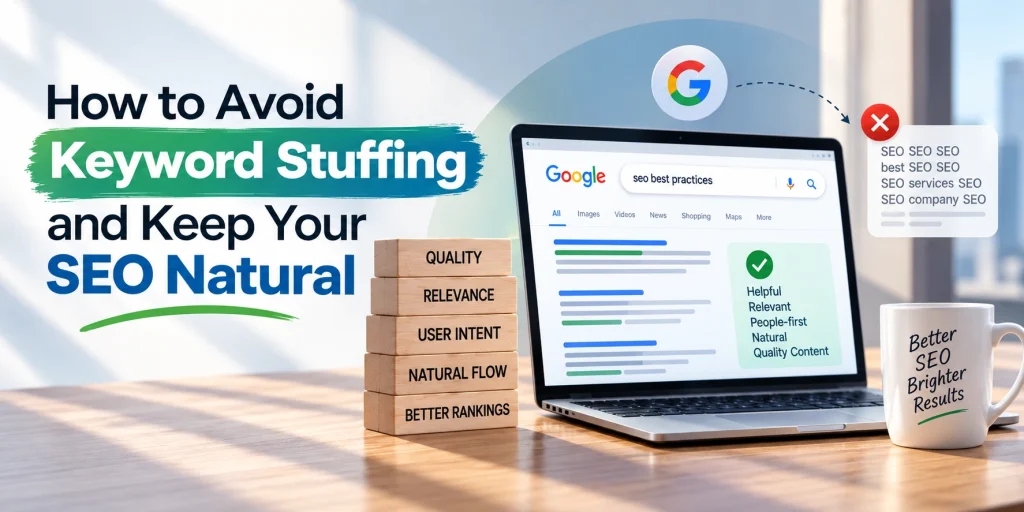
For businesses, the better approach is to create useful, people-first content and use relevant search terms where they genuinely support the topic. This guide explains the keyword stuffing meaning, common examples, and practical ways to avoid it.
In This Article
- What is keyword stuffing?
- Common keyword stuffing examples
- How to avoid keyword stuffing
- Better keyword placement techniques
- Why natural SEO content matters
What Is Keyword Stuffing?
Keyword stuffing in SEO means using the same keyword or closely related phrases excessively within a webpage, often without adding useful information. It may appear in paragraphs, headings, metadata, image alt text, or other page elements.
For example, a sentence such as “Our SEO services provide SEO services for businesses looking for SEO services” sounds forced because the keyword is repeated without improving the message.
Good SEO focuses on relevance, context, and readability, rather than repeating a phrase a certain number of times.
Common Keyword Stuffing Examples
Keyword stuffing can take several forms. Repeating an exact keyword in almost every paragraph is one obvious example. Another is creating awkward lists of keywords or locations that provide little value to visitors.
It can also happen when keywords are unnecessarily inserted into title tags, headings, URLs, image alt text, or link text. Google specifically advises against repeated words or phrases that make content sound unnatural.
The key warning sign is simple: if a sentence sounds like it was written for a search engine rather than a person, revise it.
How to Avoid Keyword Stuffing
Start by identifying the main search intent and write the content around the reader’s actual question. Use the primary keyword where it fits naturally, then rely on related terms, synonyms, and contextual language to explain the subject thoroughly.
Avoid forcing the exact keyword into every heading or paragraph. Instead, vary your wording and allow the topic to develop naturally.
A useful editing check is to read the article aloud. If a keyword sounds repetitive or interrupts the flow, replace it with a natural alternative or remove it completely.
Better Keyword Placement for SEO
Use important keywords in meaningful locations such as the page title, main heading, introduction, relevant subheadings, and body content when appropriate. Google recommends using words people search for in prominent and descriptive locations, while still prioritizing helpful content.
The goal is not to achieve a particular keyword density. The goal is to make the page clear, useful, and relevant to its intended audience.
Why Natural Content Matters for SEO
Strong SEO content answers the user’s question efficiently while providing enough context to be genuinely useful. Natural language, clear structure, relevant information, and good readability create a better experience than repetitive keyword usage.
Businesses that need help developing a balanced SEO content strategy can work with TVM Info, which provides search engine optimization and content-focused digital marketing support.
Frequently Asked Questions
Q1. What is keyword stuffing?
Ans: Keyword stuffing is the excessive or unnatural use of keywords on a webpage, usually with the intention of manipulating search visibility.
Q2. Is keyword stuffing bad for SEO?
Ans: Yes. Keyword stuffing in SEO can make content difficult to read and may violate Google’s spam policies when keywords are used unnaturally to manipulate search results.
Q3. How can I avoid keyword stuffing?
Ans: Focus on search intent and helpful content, use keywords only where they fit naturally, and include related terminology instead of repeatedly using the same phrase.
Q4. Is there an ideal keyword density?
Ans: There is no universal keyword-density percentage that guarantees better SEO. Natural usage and topical relevance are more important than reaching a specific number.
Conclusion
Avoiding keyword stuffing starts with a simple principle: write for people first. Use relevant keywords where they help explain the topic, but never sacrifice clarity just to repeat a search term. A well-structured, useful page can communicate its subject naturally without excessive optimization.
Build a More Natural SEO Content Strategy
If your website needs content that balances search visibility, keyword relevance, and reader experience, TVM Info can provide professional SEO support tailored to your business requirements.
📞 Call Us: +919004590039
📧 Email: contact@tvminfo.com
Our Business Automation Solutions:
💬 ChatKar – Turn WhatsApp chats into sales
🌟 StarCreator – Build AI automations
📧 AutoMailSend – Own your email marketing
🎯 AttractLead – Capture & convert leads automatically

Pingback: On-Page SEO Mistakes: Common Mistakes to Avoid