
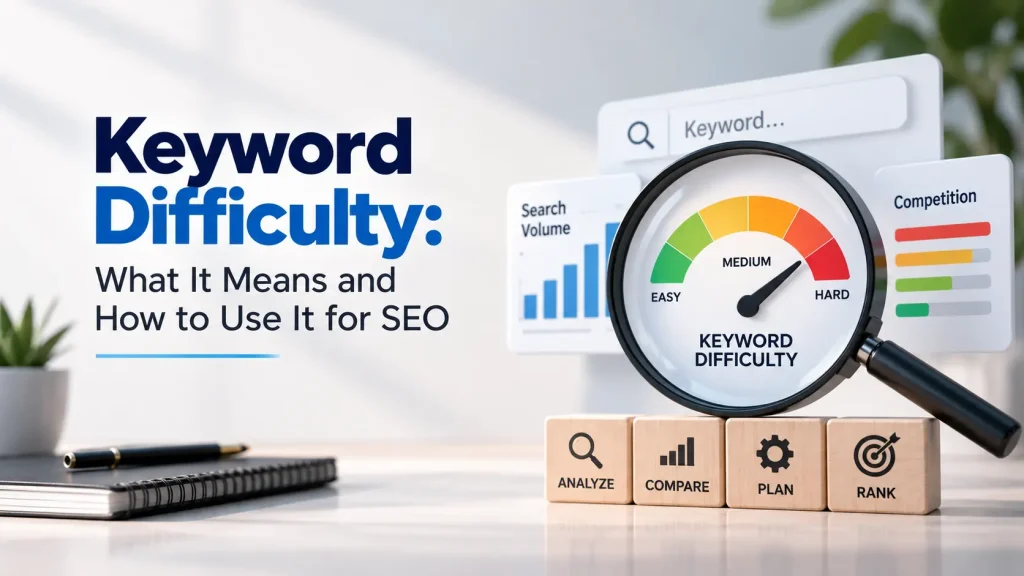
Keyword Difficulty is a useful SEO metric that helps estimate how challenging it may be to rank for a particular keyword in search results. For businesses planning an SEO strategy, understanding this metric can help prioritize realistic keyword opportunities and create a more focused content plan.
However, a keyword difficulty score should never be viewed as a guarantee of ranking success or failure. This article explains what keyword difficulty is, how works, and how to use it effectively when selecting keywords.
In This Article
- What is Keyword Difficulty?
- What affects Keyword Difficulty
- How Keyword Difficulty scores work
- How to use Keyword Difficulty for keyword research
- Important limitations to consider
What Is Keyword Difficulty?
What is keyword difficulty? In simple terms, it is an estimate of how difficult it may be for a webpage to rank organically for a specific search query.
The keyword difficulty meaning can vary depending on the SEO tool being used. Different tools use their own calculations and data sources, which means the same keyword may receive different difficulty scores across platforms.
Generally, keyword difficulty analysis considers the strength of pages already ranking for a search term. This can help marketers understand whether they are competing against highly authoritative websites or whether there may be opportunities for newer or smaller websites.
What Affects Keyword Difficulty?
Several factors can influence the competitiveness of a keyword. Common considerations include:
- Authority and strength of competing websites
- Quality and relevance of existing content
- Backlinks pointing to ranking pages
- Search intent behind the keyword
- The overall competitiveness of the search results
For example, a broad keyword may have strong competition because many established websites have created detailed content around the topic. A more specific long-tail keyword may sometimes offer a clearer opportunity because it targets a narrower search intent.
This is why keyword selection should involve more than simply choosing the lowest difficulty score.
How Does a Keyword Difficulty Score Work?
A keyword difficulty score is usually presented on a numerical scale by SEO tools. In general, a higher score indicates stronger competition, while a lower score suggests that ranking may be comparatively easier.
However, the numbers are best used as a comparison tool rather than an absolute ranking prediction.
For example, two keywords may have similar difficulty scores but completely different search results. One may contain highly relevant business websites, while another may include large publishers or established brands. Reviewing the actual search results is therefore an important part of understanding how keyword difficulty works.
How to Use Keyword Difficulty for Keyword Research
The most effective way to use Keyword Difficulty is alongside other keyword research factors.
Consider:
- Search intent – Does the keyword match what your target audience wants?
- Business relevance – Is the topic connected to your products, services, or expertise?
- Content opportunity – Can you create a genuinely useful page that answers the searcher’s query?
- Competition – Are the existing ranking pages realistically competitive for your website?
- Keyword specificity – Would a more focused variation better match your audience?
A practical SEO strategy often includes a mix of competitive keywords and more specific opportunities. This helps businesses build topical relevance while targeting searches that are meaningful to their audience.
Why Keyword Difficulty Should Not Be Used Alone
A low keyword difficulty score does not automatically mean a keyword will generate valuable traffic. Similarly, a difficult keyword may still be worth targeting if it is highly relevant to your business and supports an important content strategy.
The best approach is to combine Keyword Difficulty with search intent, content quality, relevance, and an analysis of the current search results. Strong SEO decisions come from understanding the complete opportunity not relying on one metric alone.
Frequently Asked Questions
Q1. What is keyword difficulty in SEO?
Ans: Keyword Difficulty in SEO is a metric used to estimate how challenging it may be to rank for a particular keyword in organic search results.
Q2. Is a low keyword difficulty score always better?
Ans: No. A low score may indicate less competition, but the keyword should also be relevant to your business and match the right search intent.
Q3. How keyword difficulty works in SEO tools?
Ans: How keyword difficulty works depends on the SEO tool. Tools typically analyze competitive factors related to the pages already ranking for a keyword and present an estimated difficulty score.
Q4. Should businesses target high-difficulty keywords?
Ans: Yes, when appropriate. High-difficulty keywords can still be valuable when they are relevant to important business topics. They may require stronger content, authority, and a longer-term SEO strategy.
Conclusion
Keyword Difficulty helps businesses evaluate the competitive landscape of potential keywords, but it should be used as part of a broader SEO decision-making process. By combining difficulty data with search intent, relevance, and content opportunities, businesses can build a more practical and focused keyword strategy.
Build a Smarter Keyword Strategy for Better Search Visibility
Choosing the right keywords requires more than selecting terms with low competition. A professional SEO strategy should consider business relevance, search intent, competition, and content opportunities together.
TVM Info Solutions provides professional SEO service and digital marketing strategies for businesses looking to strengthen their search visibility with a focused approach. Discuss your requirements with our team to build a strategy aligned with your business goals.
📞 Call Us: +919004590039
📧 Email: contact@tvminfo.com
Our Business Automation Solutions:
💬 ChatKar – Turn WhatsApp chats into sales: https://chatkar.com/
🌟 StarCreator – Build AI automations: https://starcreator.co/
📧 AutoMailSend – Own your email marketing: https://automailsend.com/
🎯 AttractLead – Capture & convert leads automatically: https://attractlead.in/