
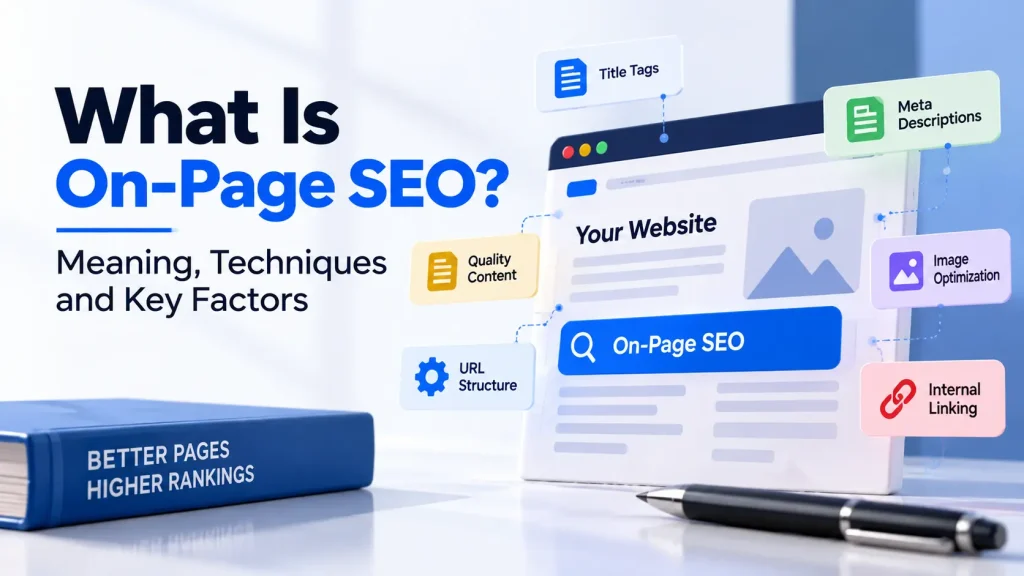
On-Page SEO is the process of optimizing individual pages on a website to help search engines understand the content and provide a better experience for users. It focuses on elements you can directly improve, including content, headings, keywords, title tags, URLs, images, and internal links.
Understanding what is on page SEO helps businesses create webpages that are more relevant, useful, and easier for search engines to understand.
In This Article
- What On-Page SEO means
- How On-Page SEO works
- Important On-Page SEO factors
- Useful On-Page SEO techniques
- Why On-Page SEO matters for businesses
What Is On-Page SEO?
The on page SEO meaning refers to optimizing the content and elements within a webpage to improve its relevance for a particular search query.
Unlike off-page activities that focus on external signals, On-Page SEO focuses on what appears directly on your website. The goal is not simply to add keywords repeatedly but to create content that clearly answers the user’s search intent.
For example, a page targeting a particular service should clearly explain the service, its benefits, relevant details, and what users can expect.
How Does On-Page SEO Work?
Search engines analyze different elements of a webpage to understand its topic and relevance. Well-organized content makes it easier for both users and search engines to identify the main subject of a page.
Effective on page SEO techniques involve matching content with user intent, organizing information with clear headings, and providing useful answers to relevant questions.
A strong webpage should also be easy to read, properly structured, and connected to other relevant pages through natural internal links.
Important On-Page SEO Factors
Several on page SEO factors can influence how effectively a webpage communicates its topic:
- Title Tags: Clearly describe the page’s main topic.
- Headings: Organize content into logical sections.
- Quality Content: Provide useful and relevant information.
- Keyword Relevance: Use important terms naturally within the content.
- URL Structure: Keep URLs clear and descriptive.
- Image Optimization: Use relevant images and accurate alt text.
- Internal Linking: Connect users to related and useful pages.
These elements should work together to create a clear and useful experience for website visitors.
Practical On-Page SEO Techniques
Start by understanding what your audience is searching for. Then create content that answers their questions clearly and completely.
Use your primary topic naturally in important areas such as the title, introduction, headings, and body content. Avoid repeating keywords unnecessarily.
Other useful techniques include improving readability, adding descriptive image alt text, using clear URLs, and reviewing whether every section provides genuine value to the reader.
Clear answers, logical organization, and strong topical relevance can also make content easier to understand across different search experiences.
Why On-Page SEO Matters for Businesses
A well-optimized website helps businesses communicate their products, services, and expertise more clearly. On-Page SEO also creates a stronger foundation for broader Search Engine Optimization (SEO) efforts.
Businesses can benefit from regularly reviewing their website content and ensuring that every important page has a clear purpose, relevant information, and a good user experience.
Professional SEO services can help businesses identify content gaps, improve webpage optimization, and develop a more effective strategy based on their website and business requirements.
Frequently Asked Questions
Q1. What is On-Page SEO?
Ans: On-Page SEO is the practice of optimizing webpage content and elements such as headings, titles, URLs, images, and internal links to improve relevance and user experience.
Q2. What are the main On-Page SEO factors?
Ans: Important factors include quality content, keyword relevance, title tags, headings, URL structure, image optimization, and internal linking.
Q3. Why is On-Page SEO important?
Ans: It helps search engines better understand webpage content while making information clearer and more useful for visitors.
Q4. Can On-Page SEO improve website visibility?
Ans: Good On-Page SEO techniques can strengthen a website’s relevance and overall SEO foundation, but search visibility depends on multiple factors and cannot be guaranteed.
Conclusion
On-Page SEO is an essential part of creating useful, well-structured, and search-friendly webpages. By focusing on relevant content, clear structure, user intent, and proper optimization, businesses can build a stronger foundation for their long-term SEO strategy.
Improve Your Website With Professional SEO Services
Effective On-Page SEO requires more than simply adding keywords to a webpage. TVM Info Solutions provides professional SEO services to help businesses improve content relevance, website structure, and overall search optimization based on their specific requirements.
📞 Call Us: +919004590039
📧 Email: contact@tvminfo.com
Our Business Automation Solutions:
💬 ChatKar – Turn WhatsApp chats into sales
🌟 StarCreator – Build AI automations
📧 AutoMailSend – Own your email marketing
🎯 AttractLead – Capture & convert leads automatically
Pingback: How to Optimize URLs for SEO: A Practical Guide