
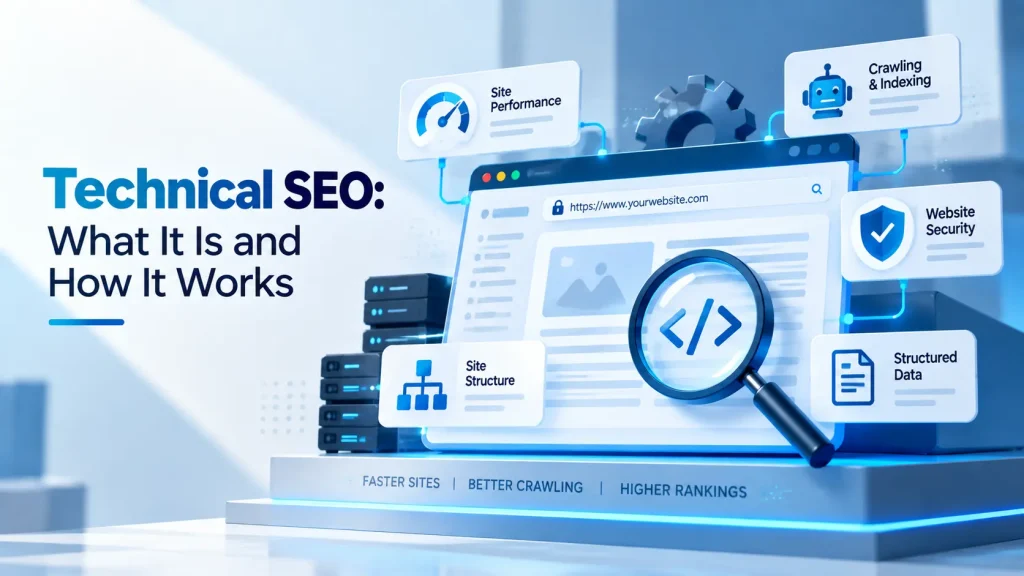
Search Engine Optimization

Technical SEO What It Is and How It Works
SEO

Technical SEO: What It Is and How It Works

Technical SEO focuses on improving the technical foundation of a website so search engines can crawl, understand, and index its pages effectively. Unlike content-focused SEO, it deals mainly with website architecture, performance, accessibility, and technical signals. Understanding what is technical SEO helps businesses identify issues that may prevent otherwise valuable content from being discovered or properly processed by search engines. In This Article What Is Technical SEO? The technical SEO meaning refers to optimizing the technical aspects of a website that affect how search engines access and interpret its content. It can include crawlability, indexability, site architecture, page speed, mobile usability, HTTPS, structured data, redirects, and XML sitemaps. Technical SEO does not replace high-quality content. Instead, it provides the foundation that allows useful content to be properly accessed and understood. How Technical SEO Works Understanding how technical SEO works starts with the relationship between a website and search-engine crawlers. Search engines discover URLs, crawl accessible pages, process their content, and determine which pages can be included in their indexes. Technical optimization helps remove unnecessary barriers in this process. For example, a website may have valuable pages, but incorrect robots.txt directives, accidental noindex tags, broken links, or poor site architecture can make those pages harder to discover or process. Key Areas of Technical SEO Optimization Effective technical SEO optimization covers several important areas. Why Technical SEO Matters for Websites Technical issues can affect the accessibility and discoverability of important pages. A technically sound website gives search engines a clearer path to its content while providing visitors with a more reliable experience. Technical SEO is especially useful when a website has many pages, frequent URL changes, complex navigation, or a recent redesign. Regular technical reviews can identify problems before they affect larger parts of the site. However, technical optimization should not be treated as a guarantee of higher rankings. It works alongside quality content, relevant information, internal linking, and other SEO practices. Common Technical SEO Issues Common problems include broken links, incorrect redirects, duplicate URLs, blocked resources, accidental noindex tags, missing sitemaps, slow pages, and poor mobile usability. A technical SEO review should therefore examine the website as a complete system rather than focusing on one isolated issue. Fixing the most relevant technical barriers first can create a stronger foundation for ongoing SEO work. Frequently Asked Questions Q1. What is technical SEO? Ans: Technical SEO is the process of improving a website’s technical foundation so search engines can crawl, process, and index important content effectively. Q2. Is technical SEO only about website speed? Ans: No. Website speed is one part of technical SEO. Crawlability, indexability, site architecture, redirects, mobile usability, HTTPS, sitemaps, and structured data can also be relevant. Q3. How often should technical SEO be checked? Ans: There is no single schedule for every website. Technical checks are particularly useful after website migrations, redesigns, major URL changes, or significant technical updates, as well as during regular SEO maintenance. Q4. Can technical SEO alone improve rankings? Ans: Technical SEO can remove technical barriers and improve accessibility, but rankings depend on many factors. Technical optimization works together with content quality, relevance, authority, and user experience. Conclusion Technical SEO provides the technical foundation that helps search engines access and understand a website. From crawlability and indexability to site architecture, mobile usability, and performance, each area contributes to a healthier website structure. A consistent technical review can help businesses identify issues early and keep their website accessible, organized, and ready for ongoing SEO efforts. Need a Stronger Technical SEO Foundation? Technical issues can become difficult to identify as websites grow, especially when pages, redirects, content, and development changes happen frequently. TVM Info Solutions provides professional SEO support that includes technical SEO, on-page optimization, content strategy, and SEO analysis. If your business needs help reviewing and improving its website’s technical SEO foundation, discuss your requirements with the TVM Info team. 📞 Call Us: +919004590039📧 Email: contact@tvminfo.com Our Business Automation Solutions: 💬 ChatKar – Turn WhatsApp chats into sales🌟 StarCreator – Build AI automations📧 AutoMailSend – Own your email marketing🎯 AttractLead – Capture & convert leads automatically

Internal Linking Strategy How to Build Better Website Connections
SEO

Internal Linking Strategy: How to Build Better Website Connections

A strong internal linking strategy helps connect related pages across a website, making it easier for visitors to discover useful information and for search engines to understand the site’s structure. Instead of adding links randomly, businesses should create a clear path between important pages, supporting content, and relevant resources. Knowing how to use internal links effectively can improve website navigation, distribute attention across related pages, and create a more organized SEO structure. This article explains how internal linking works, how to add internal links, and what makes a linking strategy useful. In This Article What Is an Internal Linking Strategy? An internal linking strategy is a planned approach to linking one page on your website to another page on the same domain. These links can connect blog posts, service pages, product pages, category pages, and other useful resources. A good strategy starts with relevance. For example, a blog article about SEO can naturally link to a related SEO service page or another useful article about keyword optimization. This creates a logical relationship between pages instead of treating every link as an isolated element. How to Use Internal Links Effectively The first step is to identify pages that naturally support one another. When deciding how to use internal links, ask whether the destination provides additional information that the reader may genuinely need. Use descriptive anchor text that explains the destination. Instead of “click here,” a phrase such as SEO services gives users clearer context. It is also useful to connect informational content with relevant commercial pages when the transition feels natural. A blog discussing search optimization, for example, can point readers toward a relevant service page without interrupting the article. How to Add Internal Links Naturally When considering how to add internal links, start by reviewing existing content and identifying meaningful connections. A practical process is: Internal links should support the reader’s journey, not simply increase the number of links on a page. Internal Linking Best Practices for SEO Effective internal linking in SEO depends on relevance, clarity, and structure. Important pages should be accessible through useful internal links rather than being isolated from the rest of the website. Use varied but descriptive anchor text where appropriate, and avoid forcing the same keyword into every link. Links should also be distributed naturally throughout useful content instead of being grouped together without context. A strong internal link building strategy can also help organize related content into logical topic groups. For example, several detailed articles about SEO can point toward a broader SEO resource, while that resource can connect readers to more specific supporting pages. Common Website Internal Linking Mistakes Common problems include linking unrelated pages, using vague anchor text, creating too many links in a small section, and leaving important pages difficult to reach. Another mistake is adding links purely for SEO without considering whether they help the reader. Every internal link should have a clear purpose. Regularly reviewing your website internal linking can reveal broken links, outdated destinations, isolated pages, and opportunities to strengthen relationships between related content. Frequently Asked Questions Q1. What is an internal linking strategy? Ans: An internal linking strategy is a planned method of connecting relevant pages within the same website to improve navigation, content relationships, and website structure. Q2. How many internal links should a page have? Ans: There is no universal number. Add internal links whenever they provide genuine value and fit naturally within the content. Relevance is more important than quantity. Q3. Does internal linking help SEO? Ans: Internal links can help search engines discover pages and understand relationships between content. They can also make it easier for visitors to navigate related information. Q4. Should every internal link use the same keyword? Ans: No. Repeating the same keyword unnecessarily can make links look unnatural. Use clear, descriptive anchor text that accurately represents each destination. Conclusion A well-planned internal linking strategy turns separate website pages into a connected information structure. By linking relevant content with descriptive anchor text and prioritizing user needs, businesses can create a website that is easier to navigate and easier for search engines to understand. The goal is not to add more links simply for SEO. The goal is to create useful connections between valuable pages. Strengthen Your Website’s Internal SEO Structure For businesses with large or growing websites, maintaining a clear linking structure can become difficult as new pages and content are added. TVM Info Solutions provides professional SEO support, including technical and on-page optimization, to help businesses build a more organized search strategy. If you need professional assistance with your website’s SEO structure and content optimization, discuss your requirements with the TVM Info team. 📞 Call Us: +919004590039📧 Email: contact@tvminfo.com Our Business Automation Solutions: 💬 ChatKar – Turn WhatsApp chats into sales🌟 StarCreator – Build AI automations📧 AutoMailSend – Own your email marketing🎯 AttractLead – Capture & convert leads automatically
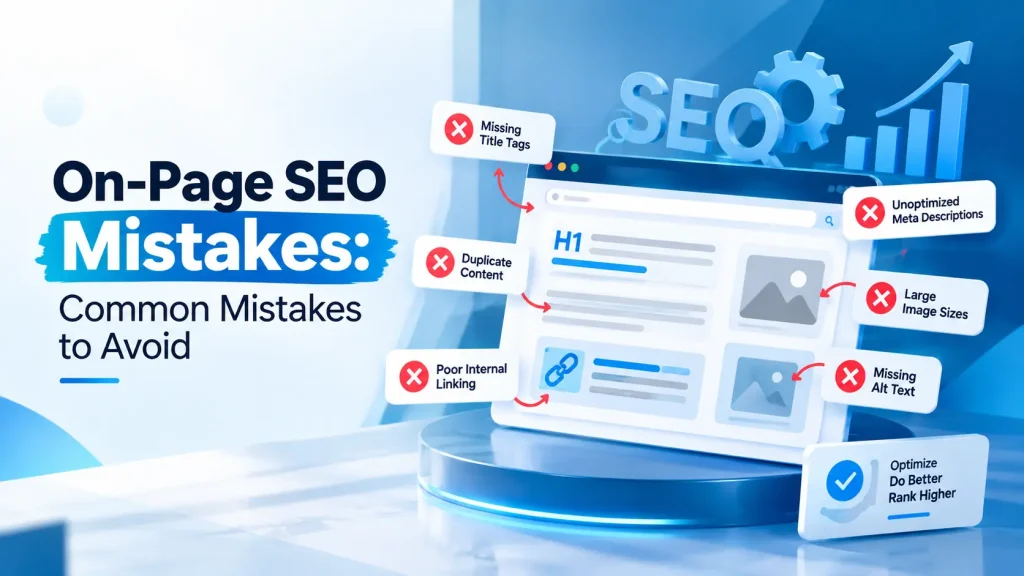
On-Page SEO Mistakes Common Mistakes to Avoid
SEO

On-Page SEO Mistakes: Common Mistakes to Avoid

On-page SEO mistakes can make otherwise useful website content harder for search engines to understand and less useful for visitors. Issues such as weak title tags, poor content structure, missing internal links, and keyword overuse can affect how effectively a page communicates its topic. Knowing the on page SEO mistakes to avoid helps businesses maintain a cleaner, more useful website. This guide covers the most common errors and provides a practical approach to reviewing important on-page elements. In This Article Common On-Page SEO Mistakes to Watch One of the most common mistakes is creating content without a clear search intent. A page should address what users are actually looking for instead of focusing only on inserting keywords. Another frequent issue is weak title tags and meta descriptions. These elements should accurately describe the page and encourage relevant clicks without making misleading claims. Poor heading structure is another problem. Use one clear H1 and logical H2 or H3 headings to organize the content. This makes longer pages easier to scan and understand. Keyword and Content Errors Keyword usage should feel natural. Repeating the same phrase excessively can make content difficult to read and may create a keyword stuffing problem. A better approach is to use the primary topic naturally alongside related terms, questions, entities, and supporting concepts. Content should answer the user’s need rather than being written around an artificial keyword frequency. Thin or repetitive content is another concern. Each important page should have a clear purpose and provide information that is genuinely useful to its intended audience. Website Structure and Technical Issues A page can have good content and still suffer from structural problems. Broken internal links, unclear navigation, duplicate page elements, missing image alt text, and poor mobile usability can reduce the quality of the overall experience. Internal links should connect related pages using descriptive anchor text. They can help visitors discover additional resources while giving search engines more context about relationships between pages. Businesses should also review whether important pages are easily discoverable within the site’s overall website structure. A Practical On-Page SEO Checklist Use this on page SEO checklist when reviewing a page: A checklist helps turn SEO review into a repeatable process rather than a one-time task. How to Avoid Recurring SEO Problems The best way to prevent common on page SEO mistakes is to review important pages regularly. New content, redesigns, URL changes, and added features can introduce problems that were not present originally. Instead of optimizing individual elements in isolation, evaluate how content, headings, links, images, navigation, and technical accessibility work together. This creates a more consistent user experience and a stronger foundation for search visibility. Frequently Asked Questions Q1. What are the most common on-page SEO mistakes? Ans: Common issues include poor title tags, weak content structure, keyword stuffing, missing alt text, broken internal links, unclear headings, and content that does not satisfy search intent. Q2. How can I check my website for on-page SEO mistakes? Ans: Start with an on-page SEO checklist covering titles, headings, content, keywords, images, internal links, mobile usability, and technical accessibility. A deeper audit can identify issues that are harder to spot manually. Q3. Does keyword stuffing hurt on-page SEO? Ans: Excessive and unnatural keyword repetition can make content difficult to read and conflicts with search-engine guidelines. Keywords should be used naturally and only where they help explain the topic. Q4. How often should on-page SEO be reviewed? Ans: There is no fixed schedule for every website. Review important pages when publishing new content, making major site changes, updating URLs, or when performance and usability issues become apparent. Conclusion Avoiding on-page SEO mistakes is less about following a rigid formula and more about maintaining clear, useful, technically accessible pages. A consistent review process can help businesses identify weak content, structural issues, linking problems, and unnecessary optimization. A practical on-page SEO checklist makes these reviews easier and helps keep SEO aligned with both user needs and search-engine requirements. Need Professional Support for On-Page SEO? Managing on-page SEO across a growing website can become difficult when pages, content, and technical elements continue to expand. TVM Info Solutions provides professional SEO support, including on-page optimization, keyword optimization, content strategy, and broader SEO analysis. If your business needs help identifying and resolving on-page SEO issues, discuss your website requirements with the TVM Info team. 📞 Call Us: +919004590039📧 Email: contact@tvminfo.com Our Business Automation Solutions: 💬 ChatKar – Turn WhatsApp chats into sales🌟 StarCreator – Build AI automations📧 AutoMailSend – Own your email marketing🎯 AttractLead – Capture & convert leads automatically
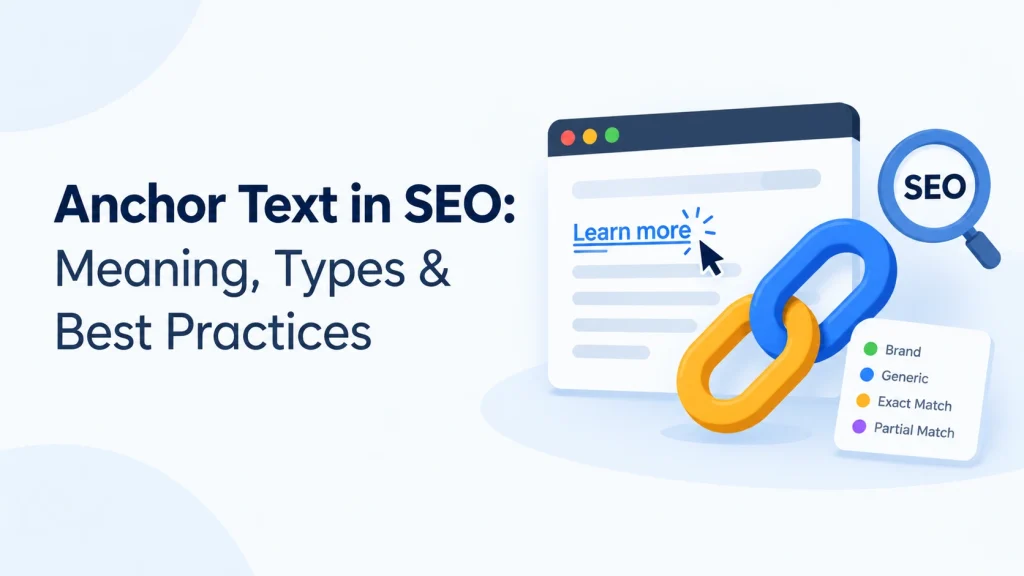
Anchor Text in SEO Meaning Types Best Practices
SEO

Anchor Text in SEO: Meaning, Types & Best Practices

Anchor text is the visible, clickable text within a hyperlink. It helps users understand where a link will take them and gives search engines additional context about the linked page. Understanding anchor text in SEO is therefore important when building internal links, creating useful content, and developing a clear website structure. The right anchor text should be descriptive, natural, and relevant to both the linking page and the destination. This guide explains what is anchor text, the main types, how it supports SEO, and practical ways to use it effectively. In This Article What Is Anchor Text in SEO? Anchor text is the clickable wording used in a hyperlink. For example, in the sentence “Explore our SEO services,” the words “SEO services” are the anchor text. The anchor text meaning goes beyond simply making a link clickable. It provides context about the page being linked to. Descriptive wording can help users understand what they can expect after clicking and can also help search engines interpret relationships between pages. For example, “website development services” provides more useful context than a generic phrase such as “click here.” How Does Anchor Text Work? When a page links to another relevant page, the anchor text acts as a small contextual signal. It connects the wording surrounding the link with the destination page. For example: Good: Learn more about website development services. Less useful: Click here to learn more. The first example clearly communicates what the linked page is about. This improves navigation and creates a more understandable website experience. For internal links, descriptive anchor text can also help visitors discover related content and important service pages without interrupting the natural flow of the article. Types of Anchor Text There are several common types of anchor text used in SEO: A natural linking strategy can use different types where they make sense instead of repeatedly forcing the same keyword. Anchor Text Best Practices Effective anchor text should be descriptive, concise, and relevant. Choose wording that naturally fits the sentence and accurately represents the destination page. Avoid changing every link into an exact keyword match. Repeatedly forcing commercial or keyword-heavy phrases can make content look unnatural and reduce readability. For internal links, consider what additional information would genuinely help the reader. If a page discusses search optimization, linking relevant terms to a detailed SEO resource can make the navigation more useful. It is also better to avoid vague anchor text when a clearer description is available. Users should have a reasonable idea of the destination before clicking. Common Anchor Text Mistakes Some common mistakes include using the same anchor text excessively, linking unrelated pages, using overly generic phrases, and adding links where they provide little value. Another issue is keyword stuffing within anchor text. Anchor text should support the reader rather than become a place to insert multiple variations of a target keyword. A practical approach is simple: write the sentence naturally first, then use the most accurate phrase as the link text. Frequently Asked Questions Q1. What is anchor text in SEO? Ans: Anchor text is the visible clickable text of a hyperlink. It helps users and search engines understand the subject or purpose of the linked page. Q2. Which type of anchor text is best for SEO? Ans: No single type is always best. Descriptive and contextually relevant anchor text is generally preferable because it clearly communicates what users can expect from the linked page. Q3. Is exact-match anchor text bad for SEO? Ans: No. Exact-match anchor text can be useful when it naturally fits the context. The problem is unnatural or excessive repetition, rather than simply using an exact phrase. Q4. Should internal links use anchor text? Ans: Yes. Relevant internal links with descriptive anchor text can help users navigate related information and help search engines understand connections between pages. Conclusion Understanding anchor text in SEO helps businesses create clearer links, better navigation, and more meaningful connections between related pages. The most effective approach is to use natural, descriptive, and contextually relevant wording instead of forcing keywords into every link. Good anchor text should ultimately serve the reader first while providing useful context about the destination page. Build a More Effective Internal Linking Strategy A strong internal linking structure requires more than adding hyperlinks to existing content. TVM Info Solutions provides professional SEO support, including on-page optimization and content-focused strategies that can help businesses create a more organized and search-friendly website structure. If your website needs a more focused SEO and internal linking approach, discuss your requirements with the TVM Info team. 📞 Call Us: +919004590039📧 Email: contact@tvminfo.com Our Business Automation Solutions: 💬 ChatKar – Turn WhatsApp chats into sales🌟 StarCreator – Build AI automations📧 AutoMailSend – Own your email marketing🎯 AttractLead – Capture & convert leads automatically
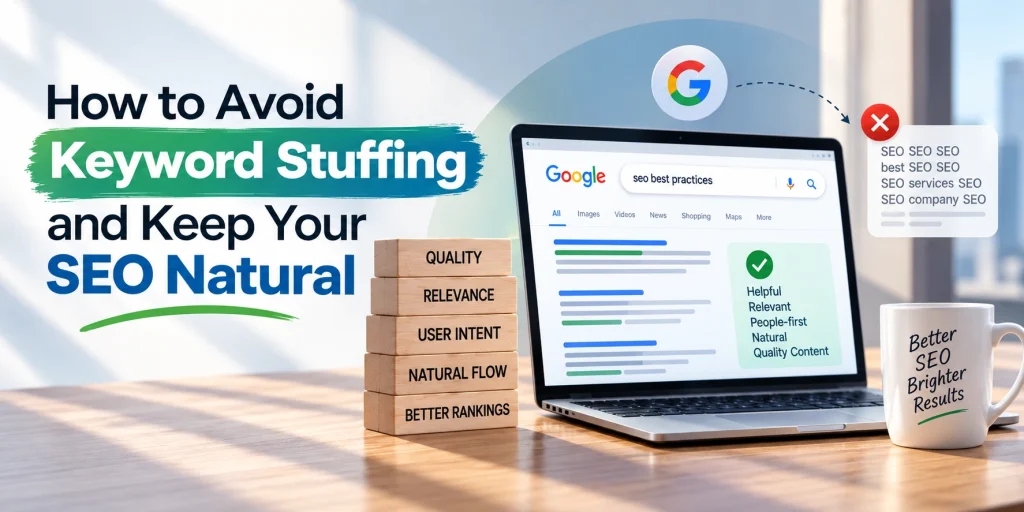
How to Avoid Keyword Stuffing and Keep Your SEO Natural
SEO

How to Avoid Keyword Stuffing and Keep Your SEO Natural

Keyword stuffing can make content feel unnatural, repetitive, and difficult to read. It happens when keywords are added excessively or in places where they do not fit naturally, usually in an attempt to influence search rankings. Google identifies keyword stuffing as a spam practice when words or phrases are repeated unnaturally or out of context. For businesses, the better approach is to create useful, people-first content and use relevant search terms where they genuinely support the topic. This guide explains the keyword stuffing meaning, common examples, and practical ways to avoid it. In This Article What Is Keyword Stuffing? Keyword stuffing in SEO means using the same keyword or closely related phrases excessively within a webpage, often without adding useful information. It may appear in paragraphs, headings, metadata, image alt text, or other page elements. For example, a sentence such as “Our SEO services provide SEO services for businesses looking for SEO services” sounds forced because the keyword is repeated without improving the message. Good SEO focuses on relevance, context, and readability, rather than repeating a phrase a certain number of times. Common Keyword Stuffing Examples Keyword stuffing can take several forms. Repeating an exact keyword in almost every paragraph is one obvious example. Another is creating awkward lists of keywords or locations that provide little value to visitors. It can also happen when keywords are unnecessarily inserted into title tags, headings, URLs, image alt text, or link text. Google specifically advises against repeated words or phrases that make content sound unnatural. The key warning sign is simple: if a sentence sounds like it was written for a search engine rather than a person, revise it. How to Avoid Keyword Stuffing Start by identifying the main search intent and write the content around the reader’s actual question. Use the primary keyword where it fits naturally, then rely on related terms, synonyms, and contextual language to explain the subject thoroughly. Avoid forcing the exact keyword into every heading or paragraph. Instead, vary your wording and allow the topic to develop naturally. A useful editing check is to read the article aloud. If a keyword sounds repetitive or interrupts the flow, replace it with a natural alternative or remove it completely. Better Keyword Placement for SEO Use important keywords in meaningful locations such as the page title, main heading, introduction, relevant subheadings, and body content when appropriate. Google recommends using words people search for in prominent and descriptive locations, while still prioritizing helpful content. The goal is not to achieve a particular keyword density. The goal is to make the page clear, useful, and relevant to its intended audience. Why Natural Content Matters for SEO Strong SEO content answers the user’s question efficiently while providing enough context to be genuinely useful. Natural language, clear structure, relevant information, and good readability create a better experience than repetitive keyword usage. Businesses that need help developing a balanced SEO content strategy can work with TVM Info, which provides search engine optimization and content-focused digital marketing support. Frequently Asked Questions Q1. What is keyword stuffing? Ans: Keyword stuffing is the excessive or unnatural use of keywords on a webpage, usually with the intention of manipulating search visibility. Q2. Is keyword stuffing bad for SEO? Ans: Yes. Keyword stuffing in SEO can make content difficult to read and may violate Google’s spam policies when keywords are used unnaturally to manipulate search results. Q3. How can I avoid keyword stuffing? Ans: Focus on search intent and helpful content, use keywords only where they fit naturally, and include related terminology instead of repeatedly using the same phrase. Q4. Is there an ideal keyword density? Ans: There is no universal keyword-density percentage that guarantees better SEO. Natural usage and topical relevance are more important than reaching a specific number. Conclusion Avoiding keyword stuffing starts with a simple principle: write for people first. Use relevant keywords where they help explain the topic, but never sacrifice clarity just to repeat a search term. A well-structured, useful page can communicate its subject naturally without excessive optimization. Build a More Natural SEO Content Strategy If your website needs content that balances search visibility, keyword relevance, and reader experience, TVM Info can provide professional SEO support tailored to your business requirements. 📞 Call Us: +919004590039📧 Email: contact@tvminfo.com Our Business Automation Solutions: 💬 ChatKar – Turn WhatsApp chats into sales🌟 StarCreator – Build AI automations📧 AutoMailSend – Own your email marketing🎯 AttractLead – Capture & convert leads automatically

What Is Internal Linking in SEO How It Works and Why It Matters
SEO

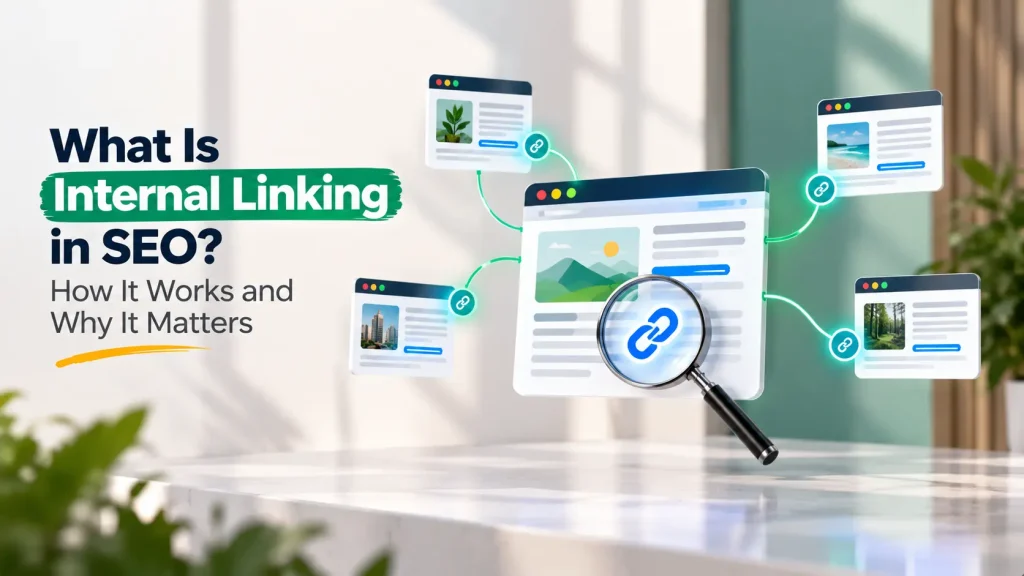
What Is Internal Linking in SEO? How It Works and Why It Matters

Internal Linking in SEO is an important practice that helps connect different pages on the same website. These links guide visitors toward relevant information while helping search engines understand the relationship between your pages and content. A well-planned internal linking structure can make a website easier to navigate, improve content discoverability, and support a stronger overall SEO strategy. In this guide, you will learn what is internal linking, how it works, why it matters, and how to use it effectively. In This Article What Is Internal Linking? Internal links are hyperlinks that connect one page of a website to another page on the same domain. For example, a blog about SEO-friendly content may link to another article about keyword placement or a relevant service page about Search Engine Optimization. The main purpose of internal linking is to create logical connections between related pages. This helps users discover additional useful information without needing to search for it separately. A strong internal linking structure should always focus on relevance. The linked page should provide genuine additional value to the reader. How Internal Linking Works in SEO Understanding how internal linking works starts with website structure. Search engines discover pages by following links, including links between pages on your own website. When relevant pages are connected, search engines can better understand how different topics relate to each other. For example, several articles about content optimization, keywords, URLs, and image SEO can support a broader topic cluster around Search Engine Optimization. Internal links also help visitors move naturally through your website. Someone reading a beginner-level article can easily continue to a more detailed guide when relevant links are placed in the right context. This creates a better navigation experience and helps important content become easier to discover. Benefits of Internal Linking The benefits of internal linking extend beyond simply connecting pages. A thoughtful strategy can help improve: Internal links are especially valuable for websites with a growing number of blogs, service pages, and resources. Without proper connections, useful pages can become difficult for visitors and search engines to discover. Best Practices for Internal Linking in SEO For effective internal linking in SEO, focus on quality rather than adding links everywhere. Use descriptive anchor text that clearly explains what users can expect after clicking. For example, “learn more about keyword placement” is more useful than a generic phrase such as “click here.” Link only to pages that are genuinely relevant to the surrounding content. A natural link should feel like a helpful continuation of the topic. It is also useful to connect related articles strategically. For example, an article about How to Write SEO-Friendly Content can naturally connect with topics such as URL optimization, image optimization, and keyword placement. Review older content regularly to identify useful opportunities for linking to newer and relevant pages. Common Internal Linking Mistakes to Avoid One common mistake is adding too many links without considering relevance. This can make content distracting and less useful. Another mistake is repeatedly using the exact same keyword-rich anchor text. Natural language and context should guide your anchor text choices. Avoid linking to unrelated pages simply because you want to promote them. The importance of internal linking comes from creating meaningful connections that help users and support a clear website structure. Frequently Asked Questions Q1. What is internal linking in SEO? Ans: Internal linking in SEO means connecting one page of your website to another relevant page on the same website using hyperlinks. Q2. Why is internal linking important? Ans: Internal linking helps users navigate your website, discover relevant content, and understand the connection between different topics and pages. Q3. How many internal links should a page have? Ans: There is no single fixed number. Add internal links when they are relevant and useful to the reader rather than adding links unnecessarily. Q4. What makes a good internal link? Ans: A good internal link connects to a relevant page, uses clear anchor text, and provides additional value related to the topic being discussed. Conclusion Internal Linking in SEO helps create a more connected, organized, and user-friendly website. By linking relevant pages naturally, businesses can improve content discovery, navigation, and topical structure. The best approach is simple: create links because they help the reader, not merely because they contain a keyword. Build a Better SEO Structure for Your Website A strong internal linking strategy requires an understanding of your website content, page relationships, and broader Search Engine Optimization goals. TVM Info Solutions provides professional SEO support to help businesses develop a structured and relevant approach to improving their search presence. 📞 Call Us: +919004590039📧 Email: contact@tvminfo.com Our Business Automation Solutions: 💬 ChatKar – Turn WhatsApp chats into sales🌟 StarCreator – Build AI automations📧 AutoMailSend – Own your email marketing🎯 AttractLead – Capture & convert leads automatically
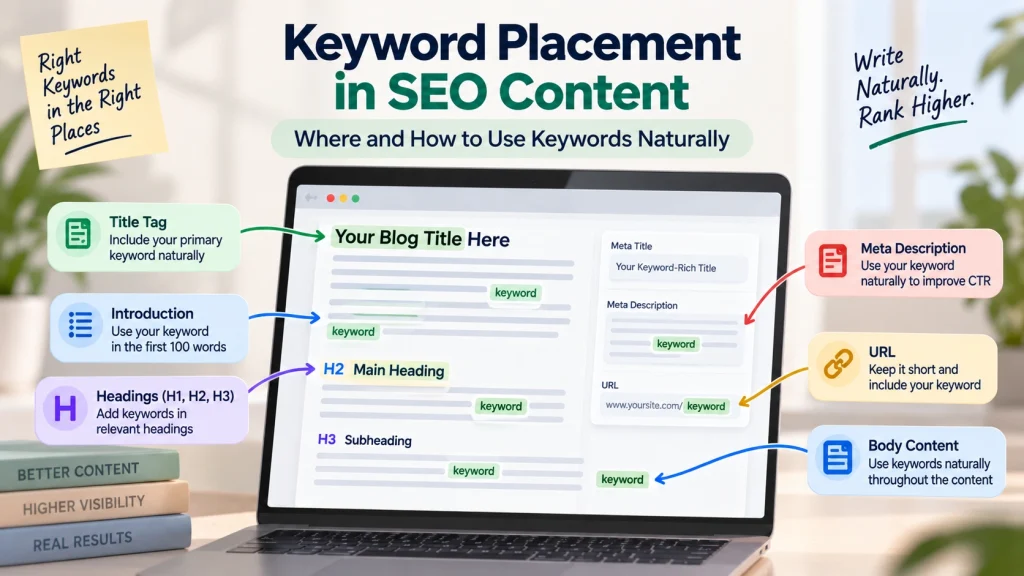
Image Alt Text SEO Guide to Writing Better Descriptions
SEO

Image Alt Text: SEO Guide to Writing Better Descriptions

Images can make a webpage more engaging, but search engines and screen readers need additional information to understand what an image represents. This is where alt text becomes important. A well-written Image Alt Text: SEO Guide helps website owners understand how to create useful image descriptions that support accessibility, user experience, and image SEO. In this guide, you will learn what is image alt text, why it matters, how to write alt text, and the key practices to follow when optimizing images for your website. In This Article What Is Image Alt Text? Alt text, also called alternative text, is a written description added to an image through its HTML or content management system. It helps screen readers communicate the meaning of an image to visually impaired users. Alt text can also provide context when an image cannot load properly. For search engines, descriptive alt text for images helps provide additional information about the visual content and its relationship to the surrounding page. For example, instead of writing: Alt text: “SEO image” A more useful description could be: Alt text: “Marketing professional reviewing website image optimization on a laptop” The second example clearly describes what the image contains. How Alt Text Supports Image SEO Image SEO involves helping search engines better understand and index visual content. Alt text is one part of a broader image optimization strategy that can also include descriptive filenames, appropriate image formats, page context, and fast-loading visuals. Good alt text should describe the image accurately while remaining relevant to the content around it. If a keyword naturally fits the description, it can be included—but forcing keywords into every image description can reduce clarity. The goal is simple: describe the image for people first. How to Write Alt Text Effectively Following strong alt text best practices can make descriptions more useful and natural: For example, if an image shows a business team analyzing website performance charts, describe that activity rather than simply adding a list of SEO keywords. How to Add Alt Text to Images Understanding how to add alt text depends on the platform you use. Most website builders and content management systems provide an Alt Text field when you upload or edit an image. Before publishing, review every important image and ask: Does this description accurately explain the image’s purpose? Decorative images that provide no meaningful information may not require descriptive alt text. Functional images, such as buttons or icons that perform an action, should communicate their purpose clearly. Common Alt Text Mistakes to Avoid Poor alt text for images often comes from trying too hard to optimize for keywords. Avoid: Effective image optimization should improve understanding, not create unnecessary text. Frequently Asked Questions Q1. What is image alt text? Ans: Image alt text is a written description that explains an image’s content or purpose, primarily helping screen readers and providing context when images cannot be displayed. Q2. Does alt text help SEO? Ans: Alt text can support image SEO by helping search engines understand the content and context of an image. However, it should always be descriptive and relevant rather than keyword-stuffed. Q3. How long should alt text be? Ans: There is no need to follow an exact word count. The best approach is to keep alt text concise while including the important information needed to understand the image. Q4. Should every image have alt text? Ans: Informational and functional images generally need appropriate descriptions. Decorative images may be handled differently because they do not add meaningful content to the page. Conclusion Writing effective alt text is a simple but valuable part of creating SEO-friendly images and improving website accessibility. Focus on accurately describing meaningful visual content, keeping descriptions concise, and using keywords only when they naturally fit the image. A thoughtful approach to image optimization for SEO can help create a better experience for both users and search engines. Improve Your Website SEO With Better On-Page Optimization Managing image alt text across a growing website can become challenging, especially when it needs to align with broader Search Engine Optimization (SEO) and content strategies. TVM Info Solutions provides professional digital marketing and SEO support for businesses looking to improve their website’s search visibility and on-page optimization. 📞 Call Us: +919004590039📧 Email: contact@tvminfo.com Our Business Automation Solutions: 💬 ChatKar – Turn WhatsApp chats into sales🌟 StarCreator – Build AI automations📧 AutoMailSend – Own your email marketing🎯 AttractLead – Capture & convert leads automatically
Keyword Placement in SEO Content Where and How to Use Keywords Naturally
SEO

Keyword Placement in SEO Content: Where and How to Use Keywords Naturally

Keyword placement in SEO content is about using relevant search terms in the right places so that both search engines and readers can clearly understand what your content is about. The goal is not to repeat a keyword as often as possible. Instead, effective placement helps communicate the topic naturally while maintaining readability and value. If you are wondering where to place keywords or how to use keywords in content, this guide explains the most important areas to focus on and the mistakes to avoid. In This Article What Is Keyword Placement in SEO Content? Keyword placement refers to the strategic use of primary keywords, secondary keywords, and related terms throughout a webpage or article. A well-optimized page should make its main topic clear without sounding repetitive. Search engines evaluate many signals to understand content, including the page title, headings, body content, URL, and overall topical relevance. For example, an article targeting Keyword Placement In SEO Content should naturally discuss topics such as content optimization, search intent, headings, keyword relevance, and readable content. Where to Place Keywords for Better SEO Knowing where to place keywords can help you structure content more effectively. Important locations include: These placements should improve clarity rather than make the content feel artificially optimized. How to Use Keywords in Content Naturally When learning how to place keywords in content, focus on meaning rather than repetition. Use your primary keyword where it fits naturally, then support it with secondary keywords, synonyms, and closely related concepts. For instance, instead of repeatedly using the same phrase, you can naturally include terms such as keyword placement best practices, SEO-friendly content, and how to use keywords in content. This approach creates stronger topical relevance while making the article easier to read. Each section should answer a specific question or provide useful information for the reader. Keyword Placement Best Practices Effective URL optimization for SEO and content optimization in general starts with understanding what the user is searching for. Before adding keywords, identify the search intent behind the topic. Follow these practical best practices: Modern search systems increasingly focus on context and topical relevance, so useful content matters more than simply repeating an exact phrase. Common Keyword Placement Mistakes to Avoid One of the biggest mistakes is keyword stuffing. Repeating the same keyword excessively can make content difficult to read and reduce its overall quality. Other common mistakes include using irrelevant keywords, creating unnatural headings, and adding keywords where they do not support the topic. The best approach is simple: use keywords to help define the subject, then provide clear and useful answers around that subject. Frequently Asked Questions Q1. What is keyword placement in SEO? Ans: Keyword placement in SEO means using relevant keywords strategically in areas such as the title, headings, introduction, body content, meta description, and URL to clearly communicate a page’s topic. Q2. Where should I place keywords in an article? Ans: You can place keywords naturally in the SEO title, H1, introduction, relevant headings, body content, meta description, and URL. Not every keyword needs to appear in every location. Q3. How many times should a keyword appear in content? Ans: There is no ideal keyword frequency that works for every article. Use the keyword naturally where it helps explain the topic, without repeating it unnecessarily. Q4. Should I use the exact same keyword in every heading? Ans: No. Use keywords in headings only when they accurately describe the section. Clear and descriptive headings are more useful than forcing the same keyword repeatedly. Conclusion Effective Keyword Placement In SEO Content is about relevance, context, and readability. Place important keywords in meaningful areas, support them with related terms, and ensure every section genuinely helps the reader. A well-structured page communicates its topic clearly without sacrificing content quality. Build More Effective SEO Content With Professional Support Creating SEO content requires more than inserting keywords into a page. Businesses need the right balance of keyword research, search intent, content structure, and on-page optimization. TVM Info Solutions provides professional Search Engine Optimization (SEO) support to help businesses build stronger and more relevant digital content strategies. 📞 Call Us: +919004590039📧 Email: contact@tvminfo.com Our Business Automation Solutions: 💬 ChatKar – Turn WhatsApp chats into sales🌟 StarCreator – Build AI automations📧 AutoMailSend – Own your email marketing🎯 AttractLead – Capture & convert leads automatically
How to Use Heading Tags for SEO and Improve Content Structure
SEO

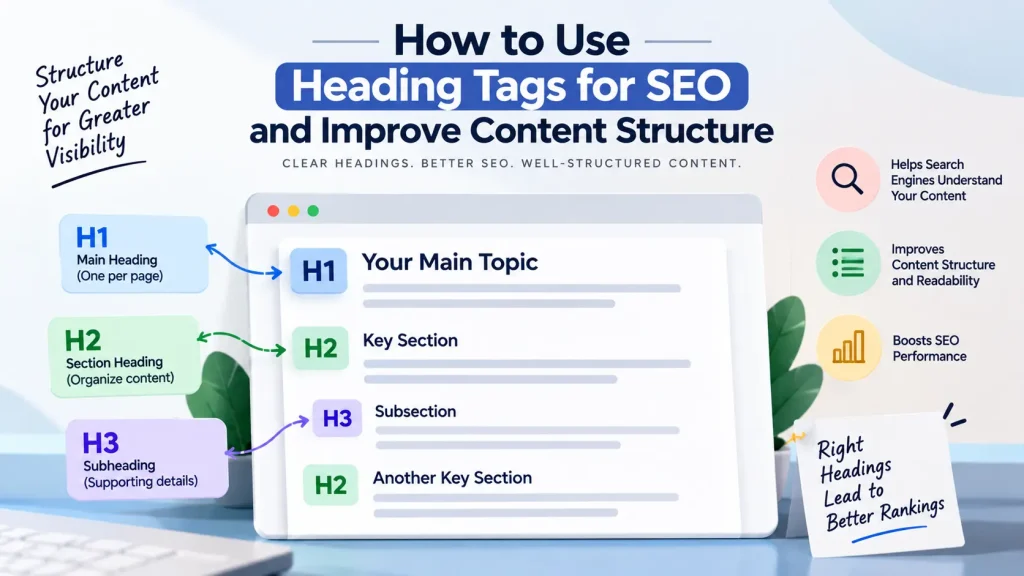
How to Use Heading Tags for SEO and Improve Content Structure

Heading tags help organize website content into a clear structure that is easier for both readers and search engines to understand. Knowing how to Use Heading Tags For SEO can improve content readability, clarify the relationship between topics, and support better on-page optimization. From the H1 to H6 tags, each heading has a specific role. This article explains what are heading tags, how to structure them correctly, and how to use them effectively without over-optimizing your content. In This Article What Are Heading Tags and Why Do They Matter? Heading tags are HTML elements used to organize content into headings and subheadings. They range from H1 to H6, with H1 generally representing the main topic and lower-level headings helping divide the content into smaller sections. For readers, headings make long pages easier to scan. For search engines, a logical structure provides useful context about the main topics and supporting information on a page. However, heading tags in SEO are not simply places to insert keywords. Their primary purpose is to create a meaningful and organized content structure. Understanding Heading Tag Hierarchy A proper heading tag hierarchy helps show how different sections relate to one another. The H1 should clearly represent the main subject of the page. H2 headings should introduce major sections, while H3 headings can be used for supporting points within an H2 section. For example: This structure makes the page easier to navigate and understand. Avoid choosing heading levels based only on font size or visual appearance. Headings should reflect the actual organization of your content. How to Use Heading Tags for SEO Effectively When learning how to use heading tags, start with the structure of your content rather than keywords. First, create a clear H1 that accurately describes the page’s main topic. Then divide the content into logical H2 sections based on the questions or subjects your audience wants answered. Use H3 headings only when a major section needs further explanation. Each heading should accurately describe the content below it. Relevant keywords can be included naturally when they help explain the topic. For example, a heading such as “Best Practices for Heading Tag Optimization” is useful because it clearly tells readers what the section covers. Common Heading Tag Optimization Mistakes Poor heading tag optimization can make content confusing and difficult to scan. Common mistakes include: A well-written heading should help readers quickly understand what information follows. Clear structure and relevance are more valuable than trying to force keywords into every section. Best Practices for Well-Structured Content Use headings to create a natural flow from the main topic to supporting details. Keep headings concise, descriptive, and relevant to the content beneath them. A strong content structure can also improve the overall user experience by helping visitors find information more easily. When combined with quality content and effective Search Engine Optimization (SEO) practices, properly organized headings contribute to a clearer and more accessible website. Frequently Asked Questions Q1. What are heading tags? Ans: Heading tags are HTML elements, from H1 to H6, used to organize webpage content into a structured hierarchy of headings and subheadings. Q2. How many H1 tags should a page have? Ans: In most cases, using one clear H1 for the primary topic helps maintain a simple and understandable page structure. Q3. Do heading tags directly improve SEO rankings? Ans: Heading tags help organize content and provide context about a page. They should be used primarily to improve structure and readability rather than as a shortcut to higher rankings. Q4. Can keywords be used in heading tags? Ans: Yes, relevant keywords can be used naturally when they accurately describe the section. Avoid forcing keywords into headings unnecessarily. Conclusion Knowing how to Use Heading Tags For SEO helps create content that is easier to read, navigate, and understand. Focus on a logical heading tag hierarchy, clear topic organization, and headings that accurately describe your content. Build Better Content Structure With Professional SEO Support A well-structured website requires more than properly placed headings. TVM Info Solutions provides professional SEO and digital marketing service to help businesses improve on-page content, website structure, and search visibility through relevant optimization strategies. 📞 Call Us: +919004590039📧 Email: contact@tvminfo.com Our Business Automation Solutions: 💬 ChatKar – Turn WhatsApp chats into sales🌟 StarCreator – Build AI automations📧 AutoMailSend – Own your email marketing🎯 AttractLead – Capture & convert leads automatically
How to Write SEO Friendly Meta Descriptions That Encourage Clicks
SEO

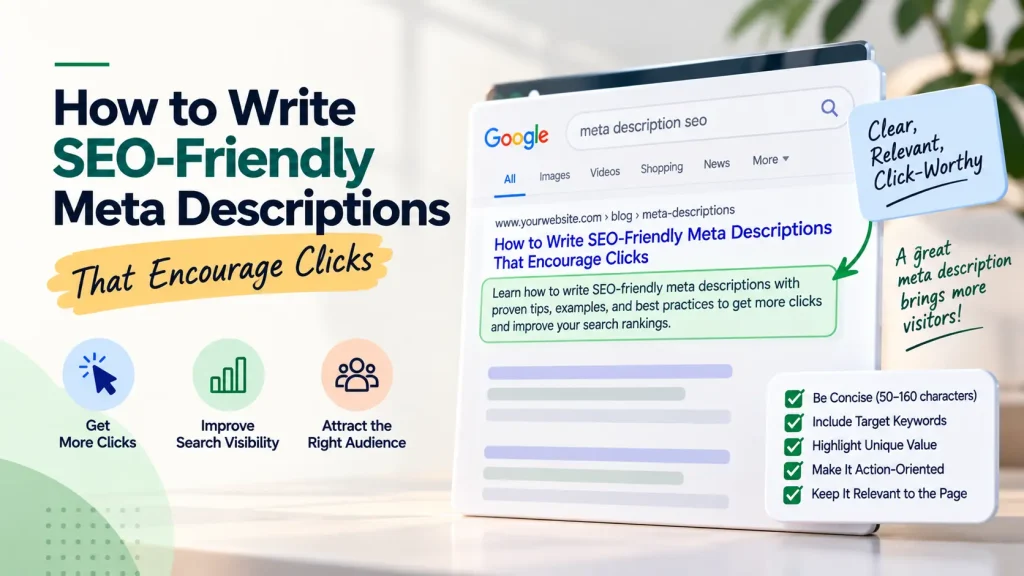
How to Write SEO-Friendly Meta Descriptions That Encourage Clicks

A well-written meta description can help users understand what a webpage offers before they visit it. While it is not a direct ranking factor, a relevant and compelling description can improve how your page appears in search results and encourage qualified users to click. To Write SEO-Friendly Meta Descriptions, focus on accurately summarizing the page, matching search intent, and giving users a clear reason to visit. This article explains how to write meta descriptions, the ideal approach to length, and important meta descriptions for SEO best practices. In This Article What Is a Meta Description? If you are asking what is a meta description, it is a short HTML summary that describes the content of a webpage. Search engines may use it as the snippet displayed below the page title in search results. A good description should quickly answer an important question: What will the user find on this page? For example, instead of writing a vague description such as “Learn more about our services,” a specific description explains the actual value of the page. Clear, relevant, and user-focused descriptions can make search listings easier to understand. How to Write Meta Descriptions That Match Search Intent The best approach to how to write meta descriptions is to begin with the page’s purpose and the user’s likely search intent. A strong meta description should: For example, if a page explains SEO services, the description should clearly mention the type of SEO support offered rather than making broad or unrelated claims. The goal is not simply to attract clicks. The description should set the right expectation so visitors find content relevant to their search. Use Keywords Naturally in Meta Descriptions for SEO Keywords can help reinforce the relevance of a page, but they should never make the description sound repetitive or unnatural. When creating meta descriptions for SEO, include the primary topic when it genuinely fits the sentence. You can also use related terms that help explain the page more clearly. Avoid repeating the same keyword multiple times. Instead, write for the reader first. A natural description is usually more useful than one overloaded with search terms. Relevance, clarity, and accuracy should guide your writing. Understanding the Meta Description Character Limit There is no single guaranteed meta description character limit because search engines can display different amounts of text depending on the device, query, and available space. Instead of writing to an exact character count, focus on creating a concise and meaningful summary. Keep the most important information near the beginning and avoid unnecessary words. It is also important to remember that search engines may sometimes generate a different snippet from the page content when they consider it more relevant to a user’s query. Title and Meta Description SEO Best Practices Effective title tag optimization and meta description writing work together to create a clear search result listing. Follow these practical best practices: For businesses managing many webpages, maintaining consistent on-page optimization can become challenging. A structured Search Engine Optimization (SEO) strategy helps ensure important page elements support both search visibility and user experience. Frequently Asked Questions Q1. How do I write an SEO-friendly meta description? Ans: Write a concise summary that accurately explains the page, matches user intent, and naturally includes the main topic or relevant keyword. Q2. What is the ideal meta description length? Ans: There is no fixed length that guarantees full display. Focus on writing a concise, useful description with the most important information placed early. Q3. Should every page have a unique meta description? Ans: Important pages should have unique descriptions whenever possible. This helps users and search engines better understand the specific purpose of each page. Q4. Do meta descriptions directly improve rankings? Ans: Meta descriptions are not generally considered a direct ranking factor. However, relevant descriptions can improve how users understand your search result and may encourage qualified clicks. Conclusion To Write SEO-Friendly Meta Descriptions effectively, focus on clarity, relevance, search intent, and accurate page summaries. A strong description should help users understand what they can expect before clicking. When combined with quality content and effective on-page SEO, well-written meta descriptions can contribute to a clearer and more useful search experience. Improve Your Website’s Search Listings With Professional SEO Support Writing effective titles and meta descriptions is an important part of maintaining a well-optimized website. TVM Info Solutions provides professional SEO support to help businesses improve important on-page elements and strengthen their overall search strategy.

Scroll to Top